The Cost of Waiting on Foundation Repair in Dallas
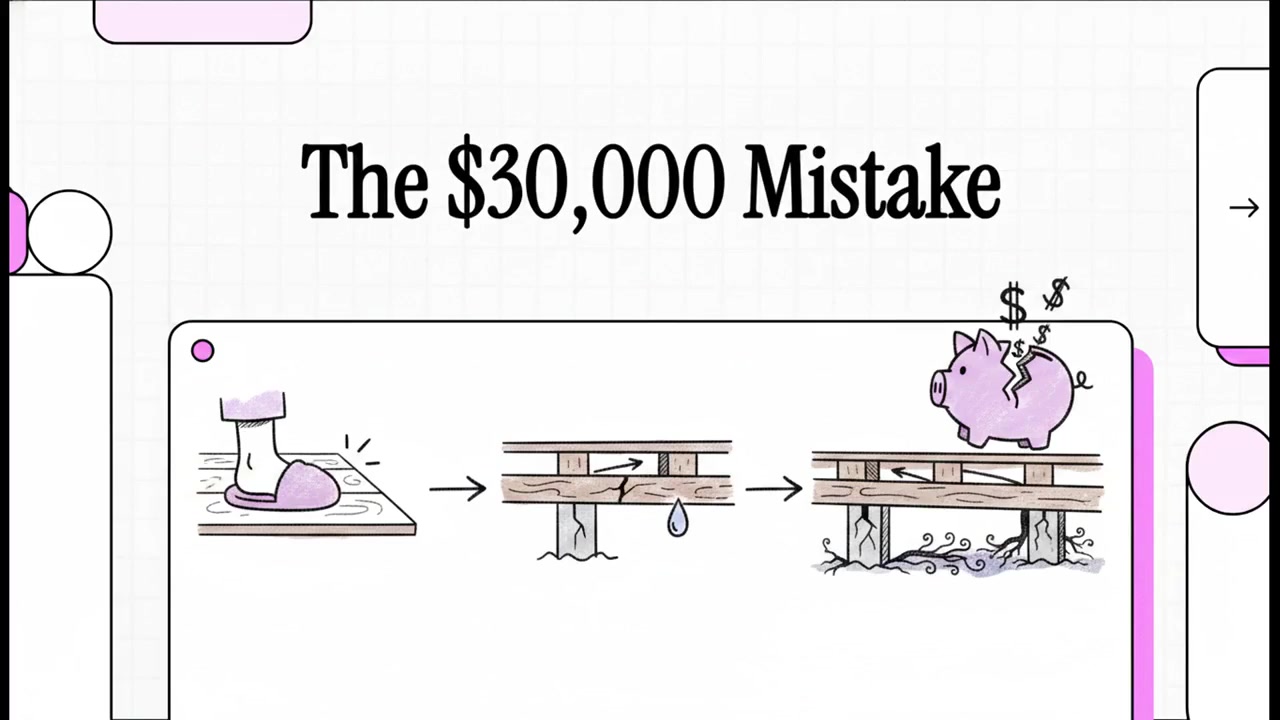
A door that drags on the carpet reads as a quirk, not a bill. Structurally it is the visible end of a load path that has already shifted: a support settles a fraction of an inch, the floor plane drops, the frame racks, and a rectangular opening becomes a parallelogram. The reason that matters financially is not the door. It is that foundation failure is progressive, and the published price of the fix moves by an order of magnitude as the damage spreads from targeted support into beam replacement and full underpinning. The American Society of Civil Engineers estimates that one quarter of all US homes are affected by expansive soils,.
How the price actually escalates
It helps to think in phases rather than in years. In the early phase, movement is local and the fix is local: adjust or replace a few supports under one bay, correct the drainage that caused the wetting, and the job sits at the low end of the published bands — a few thousand dollars. In the middle phase, settling has spread across more than one bay, beams are deflecting, and rigid drywall finishes tear at door and window corners because they cannot flex. Now the scope includes multiple supports and framing repair, and the published band climbs. In the late phase, rotted or crushed members must be replaced rather than reinforced, floor planes are significantly displaced, and rigid plumbing lines under the floor come under stress and can rupture, adding water damage to a structural bill. That is the phase where owners are quoted the top of the ranges, and where full replacement becomes an alternative. Published national benchmarks across HomeAdvisor, Angi, Fixr and Thumbtack put the spread plainly: crack sealing at $250–$800, settling and sinking repair at $5,000–$25,000, underpinning at $10,000–$40,000, piers at $1,000–$3,000 each installed, and full foundation replacement at $20,000–$100,000.
| Phase | What is happening | Published cost band |
|---|---|---|
| Early: local movement | One bay of supports settling; a sticky door; first fungal staining | Crack sealing $250–$800; targeted support at the low end of the pier range |
| Middle: spreading | Beams sagging across bays; diagonal cracks at openings; visible deflection | Settling and sinking repair $5,000–$25,000 |
| Late: structural | Members crushed or rotted and replaced; displacement; stressed plumbing | Underpinning $10,000–$40,000; replacement $20,000–$100,000 |
| All phases | Per-pier work, the unit that drives most totals | $1,000–$3,000 per pier, count set by engineering |
Why Dallas homes move in the first place
The mechanism is differential movement, not total settlement. Dallas County's governing soil is the black, waxy Houston Black clay formed in the Taylor Marl, mapped across the Blackland Prairie with high shrink-swell potential. The NRCS series description quantifies it: a fine, smectitic, thermic Udic Haplustert, very deep, moderately well drained and very slowly permeable, with 40–60% clay in the particle-size control section, cracks reaching 1.3–10 cm (about ½ to 4 inches) wide at 12 inches depth in dry periods, slickensides between 24 and 80 inches, and knolls standing 3–18 inches above the adjacent depressions every 10–24 feet. Water enters it rapidly when dry and cracked and very slowly when moist. Wet one edge with a downspout and crack the other with summer drought, and the two ends of the same slab are moving in opposite directions. The Dallas Residential Code treats that as a design condition: section R403.1.8 requires design under IBC 1808.6, and defines a soil as expansive at a plasticity index of 15 or more (ASTM D4318), more than 10% passing the No. 200 sieve (ASTM D422), or an expansion index over 20 (ASTM D4829). Dallas also splits between post-1970s slab-on-grade homes and older pier-and-beam neighbourhoods, and the two fail differently — slabs crack and tilt, while pier-and-beam floors sag when piers punch, beams rot or shims fall out.
| Damage type | Published range | Typical trigger in Dallas |
|---|---|---|
| Cracking | $250–$800; epoxy injection $200–$1,000 | Seasonal shrink-swell; first visible symptom |
| Leaking | $2,000–$7,000 ($2,000–$10,000 wider scope) | Plumbing failure under a slab, or wall infiltration |
| Settling or sinking | $5,000–$25,000 | Dry-cycle shrink losing bearing under a footing |
| Pier-and-beam repair | $2,000–$15,000; replacement piers $2,000–$6,000 each | Decay and settling in older housing stock |
What the diagnosis costs, and why it is the cheapest money in the project
Every published guide prices the diagnosis separately from the repair, and the diagnosis is two orders of magnitude smaller. A structural engineer's inspection and report runs $340–$780 from HomeAdvisor, $566–$1,650 nationally from Thumbtack, or $300–$1,000 as a structural report from Angi; a soil or geotechnical report runs $500–$3,000 from Angi and $1,000–$5,000 from Fixr. Those are not the same product: a structural report evaluates the building, a geotechnical report evaluates the ground, and on expansive clay the second is what establishes how deep the fix has to go. Permits are close to a rounding error on the ticket but matter for documentation. Dallas charges a base permit fee of $125.00 for alterations or repairs of single-family and duplex structures, plus $100 for each additional trade, with a master permit minimum of $100.00, and the city records residential foundation repair as a distinct permit with a building final inspection. Comparing bids without that engineering basis is guesswork: two quotes for the same house can differ by the entire method, from a $500 mudjacking band to a $30,000 pier job.
| Line item | Published figure | Source |
|---|---|---|
| Structural engineer inspection and report | $340–$780 | HomeAdvisor |
| Structural report (alternate band) | $300–$1,000 | Angi |
| Soil / geotechnical report | $500–$3,000 ($1,000–$5,000 second guide) | Angi / Fixr |
| Dallas permit, single-family repair | $125.00 base plus $100 per additional trade | City of Dallas fee schedule |
| Home improvement loan APR context | About 7% to 36% APR | Bankrate |
What delay costs beyond the repair
The second bill arrives at resale. Texas Property Code section 5.008 requires a seller of residential property of not more than one dwelling unit to deliver a written Seller's Disclosure of Property Condition, and the form asks about known defects in structural components including foundation and slab. An undisclosed condition that later proves known to the seller is exactly the risk the notice allocates. The financial read is asymmetric: HomeAdvisor's guide notes that documentation showing a structure was properly stabilised, especially with piers in regions known for shifting soil, often reads as a plus rather than a problem, while skipping repairs can cut the sale price and shrink the buyer pool. The geological literature records the same pattern from the other direction — CGS observed that cheap cover-up repairs followed by a quick sale are a documented behaviour, which is precisely why buyers now ask for the engineer's letter and the warranty transfer. Financing deserves equal weight: at the top of the published APR band, roughly 36%, a $10,000 foundation loan costs far more in interest than the same principal at roughly 7%, and that spread is often wider than the difference between two competing bids.
| Consequence | What changes | Who pays |
|---|---|---|
| Disclosure | Known foundation defects must be disclosed under Texas Property Code 5.008 | Seller |
| Negotiation | Buyer may demand repair, a credit, a price reduction or an escrow holdback | Seller, in price |
| Buyer pool | Skipped repairs can cut sale price and shrink the pool of interested buyers | Seller |
| Financing | About 7%–36% APR band; the spread can exceed the gap between two bids | Owner financing the work |
Planning only — have a licensed professional engineer evaluate your foundation. In Texas that means a professional engineer licensed by TBPELS; a seal from any other state is not valid here, and the report — not a contractor's walkthrough — is what makes two bids comparable.
Sources
- HomeAdvisor, How Much Does Foundation Repair Cost in 2026: https://www.homeadvisor.com/cost/foundations/repair-a-foundation/
- Angi, How Much Does Foundation Repair Cost (2026 data): https://www.angi.com/articles/how-much-does-foundation-repair-cost.htm
- Fixr, How Much Does It Cost to Repair a Foundation in 2026: https://www.fixr.com/costs/repair-foundation
- Thumbtack, How much do foundation repairs cost: https://www.thumbtack.com/p/foundation-repair-cost
- Bankrate, home improvement loan rates: https://www.bankrate.com/home-equity/home-improvement-loan-rates/
- USDA NRCS, Official Series Description — Houston Black series: https://soilseries.sc.egov.usda.gov/OSD_Docs/H/HOUSTON_BLACK.html
- Texas Property Code section 5.008, Seller's Disclosure of Property Condition: https://statutes.capitol.texas.gov/?tab=1&code=PR&chapter=PR.5&artSec=5.008