Crawl Space Wiring in Dallas: Where the Code Draws the Line
There is a version of this story that circulates widely and it is not quite right. Standard white non-metallic (NM) cable is not automatically illegal simply because it runs beneath a house. The National Electrical Code both permits NM cable in crawl spaces under conditions and prohibits it in wet or damp locations, and the two provisions are what a homeowner actually has to reconcile. Section 334.15(C) addresses unfinished basements and crawl spaces directly, allowing cable run at angles with joists to be secured to the lower edges of joists above a minimum conductor size, with smaller cables run through bored holes or on running boards. Section 334.12(B)(4) prohibits Type NM and NMS cable in wet or damp locations. Whether your crawl space is a damp location is the entire question — and in Dallas, where a dirt floor plus summer humidity plus cracked expansive clay produce standing condensation, the answer is frequently yes.
What the code prohibits, permits, and leaves to judgement
The NEC defines the terms precisely, which matters because the prohibition is written in those terms. A wet location is one subject to saturation or in direct contact with the earth; a damp location is one protected from weather but subject to moderate degrees of moisture, and the code's own examples include some basements. An Indiana state interpretation of the identical provision, issued when the same question came up for exterior cavity walls, explains the reasoning: the code looks only at the environment of the cable itself, and the prohibition is not intended to fire where moisture appears only because another building component has failed. That logic cuts both ways in a crawl space. A dry, well-drained, vapour-barriered crawl space is defensible. One with wet soil, tide marks on the wall, or condensation dripping from joists is not, and cable there is a prohibited installation regardless of how good it looks from the access hatch. Type NMC cable, which carries a corrosion-resistant jacket, is permitted in dry, moist, damp and corrosive locations — which is why it appears in compliant crawl space work.
| Cable or condition | Code position | What it means below the floor |
|---|---|---|
| NM cable in a dry crawl space | Permitted under 334.15(C) with joist or running-board conditions | Legal if the space is genuinely dry and the support rules are met |
| NM cable in a damp location | Prohibited by 334.12(B)(4) | Wet soil or condensation makes the installation a violation |
| Type NMC (corrosion-resistant jacket) | Permitted in dry, moist, damp and corrosive locations | The compliant choice where moisture cannot be eliminated |
| Splices and junction boxes | Must be in accessible, covered boxes | Anything taped and buried under insulation is a defect |
| Knob-and-tube or aluminium under wet insulation | Not permitted where the installation depends on air cooling | Serious hazard; some carriers decline the risk |
The failure chain, and why rodents accelerate it
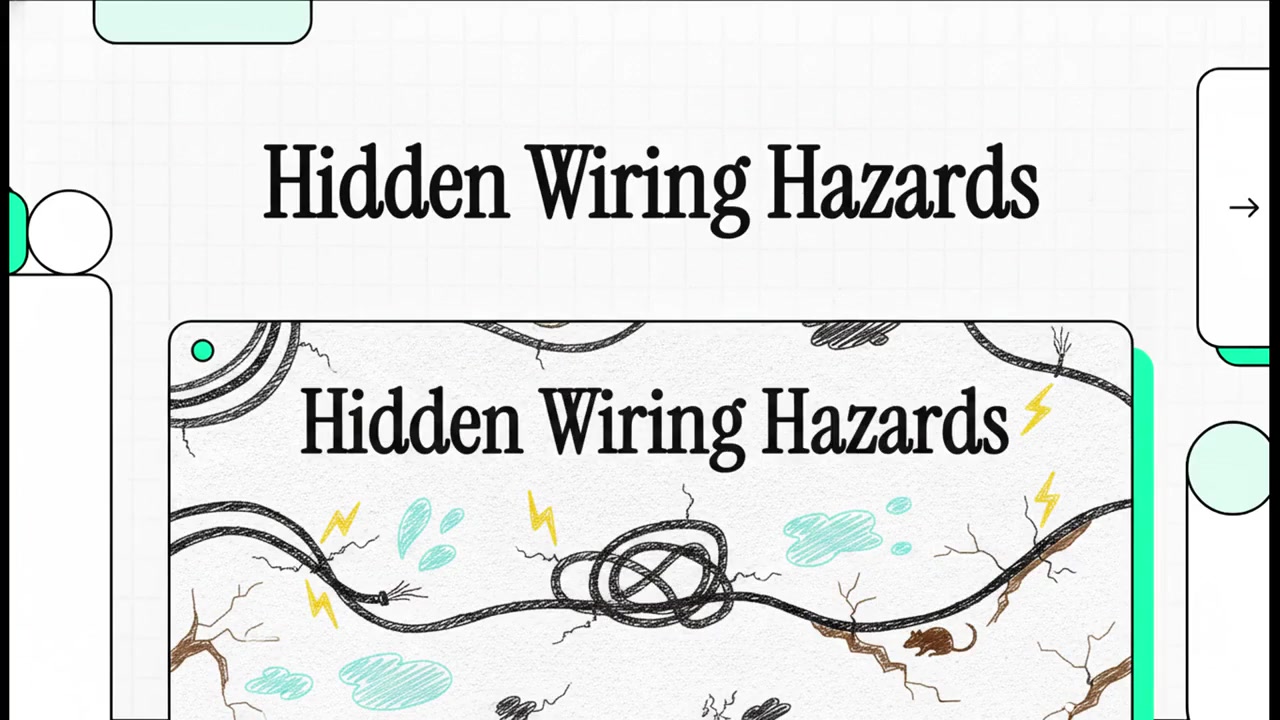
An illegal cable does not fail all at once. Moisture cycling makes the plastic jacket brittle until it cracks; the copper conductors are then exposed to damp air; the copper corrodes; and that corrosion acts as a resistor on the circuit, which converts electrical energy into heat at the corroded point. Where that heat sits against dry framing, the fire risk is real. Rodents add mechanical damage: their incisors grow continuously, so gnawing is a biological necessity, and cable jackets are a prime target. Exposed copper plus compromised insulation is the two-ingredient recipe for an arc fault — and the national statistics show why this deserves attention. NFPA's research reports an annual average of 46,652 home electrical structure fires in the United States for 2020–2024, causing 527 civilian deaths, 1,580 civilian injuries and $2.4 billion in direct property damage each year, with 28% of those fires occurring in the winter months.
| Warning sign | Likely cause | What to do |
|---|---|---|
| Breaker trips repeatedly with no load change | Intermittent fault on a damaged conductor | Stop using the circuit; have an electrician trace it |
| Lights flicker on one circuit | Loose or corroded connection raising resistance | Test the connections and terminations |
| Burning smell near an outlet or panel | Overheating at a damaged or loosened joint | Cut power at the panel and call an electrician immediately |
| Green oxidation or heavy rust at terminations | Chronic moisture on copper and steel parts | Treat as a moisture problem plus an electrical repair |
| Chewed jacket or nesting debris | Rodent activity against cable runs | Extermination plus a wiring inspection |
Why Dallas makes this worse than a generic crawl space
Dallas's crawl spaces sit under the same soil that moves the house. Houston Black clay is a fine, smectitic, thermic Udic Haplustert — very deep, moderately well drained, very slowly permeable, with 40–60% clay in the particle-size control section and cracks reaching 1.3–10 cm (about ½ to 4 inches) wide at 12 inches depth in dry periods. Water enters that soil rapidly when it is dry and cracked and very slowly when it is moist, so rain is stored within a narrow band against the foundation and released slowly into the crawl space. Add heat: Dallas sits in hot-humid IECC climate zones where warm outdoor air entering a cooler crawl space reaches its dew point on the first cold surface it meets. Older Dallas neighbourhoods add a second risk, because pier-and-beam stock is exactly where knob-and-tube and early aluminium wiring survive, and those installations rely on open air for cooling that wet insulation removes. Texas regulates the trades that touch this: electrical work must be performed by a licensed electrician, licensed through TDLR, and the City of Dallas states that general building work on your own property does not require a licence while plumbing, mechanical and electrical work does.
| Item | Published figure | Source |
|---|---|---|
| US home electrical structure fires | 46,652 per year (2020–2024 average) | NFPA |
| Deaths, injuries, direct damage | 527 deaths; 1,580 injuries; $2.4 billion per year | NFPA |
| Indoor relative humidity target | Below 60%; 30–50% preferred | EPA |
| Crawl space framing clearance | 18 in below joists; 12 in below chassis beam | HUD |
| Electrical repair and re-wire | Quoted separately by the electrician | No national benchmark published |
Fix the water and the structure, then the wiring
The sequence matters because rewiring a crawl space that stays wet simply resets the clock. Eliminate the moisture sources first: reset grade to the code's 6 inches of fall in the first 10 feet, extend downspouts and clear gutters, and confirm with the City of Dallas before discharging any sump or footing drain to a storm inlet, because City Code section 19-118.2 restricts what may enter the stormwater system. Have a licensed engineer evaluate the structure if the framing shows moisture damage or movement, because replacing cable while joists are decaying is work done twice. Only then bring in a licensed electrician to correct the wiring with cable rated for the environment, accessible covered junction boxes, and ground-fault protection for receptacles in damp locations. Finish by keeping humidity in the EPA's target band with a vapour barrier or full encapsulation with dehumidification.
Treat the electrical scope as a specification rather than a repair list: cable rated for the environment the crawl space actually has, conductors supported on joist edges or running boards rather than draped over soil, every splice in an accessible covered box, and ground-fault protection on crawl space receptacles. Ask the licensed electrician to state in writing which cable type was installed and why it suits that location, because that one sentence is what a future buyer's inspector, a permitting office or an insurer will ask for.
Planning only — have a licensed professional engineer evaluate your foundation. Electrical corrections and structural repairs are separate licensed scopes; a crawl space often needs both, and neither one substitutes for the other.
Sources
- Indiana Department of Homeland Security, Written Interpretation of IEC 334.12(B)(4), uses not permitted in wet or damp locations: https://www.in.gov/dhs/files/Section-334.12B4.pdf
- Washington State L&I, WAC 296-46B-334 Nonmetallic-sheathed cable (NEC 334.15(C) crawl space provisions): https://lni.wa.gov/licensing-permits/_docs/WAC-296-46B-334-nonmetallic-sheathed-cable-May-2025.pdf
- Electrical Construction & Maintenance, Is NM Cable Acceptable in a Wet Location?: https://www.ecmag.com/magazine/articles/article-detail/codes-standards-nm-cable-acceptable-wet-location
- NFPA, Home Electrical Fires research report: https://nfpa.org/education-and-research/research/nfpa-research/fire-statistical-reports/home-electrical-fires
- USDA NRCS, Official Series Description — Houston Black series: https://soilseries.sc.egov.usda.gov/OSD_Docs/H/HOUSTON_BLACK.html
- US EPA, A Brief Guide to Mold, Moisture and Your Home: https://www.epa.gov/mold/brief-guide-mold-moisture-and-your-home
- City of Dallas, stormwater management and City Code 19-118.2 discharge restrictions: https://dallas.gov/
- Texas Department of Licensing and Regulation, electrician licensing and lookup: https://www.tdlr.texas.gov/