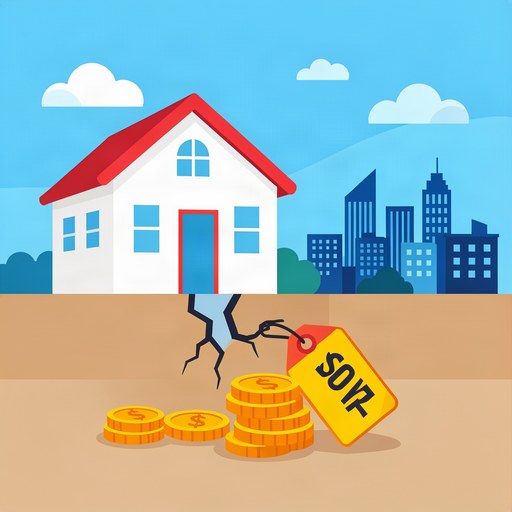
Termites or Wood Rot? The Probe Test for a Dallas Foundation
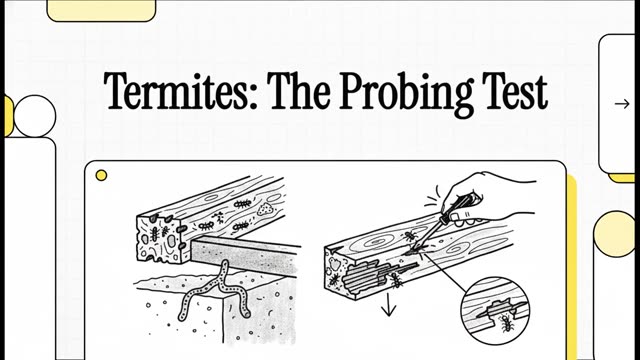
The damage that ends load-bearing framing rarely starts in the living room. Subterranean termites and wood-decay fungi both work from the inside of a member outward, leaving the surface layer intact until the core is gone. A joist can look clean under a bright flashlight while its interior has been hollowed along the grain. That is why the single most useful test a Dallas homeowner can run below the floor is not visual. It is a probe test with a screwdriver, and it produces two pieces of evidence: a sound and a resistance reading.
How the probe test works, and what each result means
Take a heavy screwdriver down with a flashlight. Tap the plastic handle firmly against the joist or sill plate and listen, then push the metal tip into the wood and feel how far it travels. Healthy, sound framing rings sharply and stops the tip cold. A dull, hollow thud means material has been removed from inside the member. A tip that sinks in with little resistance means the wood has lost its structure. Compare several joists in the same bay: termite and rot damage is rarely uniform, and the contrast between a solid member and a soft one is the evidence. Record what you find — date, location, and whether the wood is damp, stained, or carrying fungal growth — because that record becomes the basis for an engineer's evaluation and for any insurance argument about cause.
| Feedback | What it indicates | Next step |
|---|---|---|
| Sharp ring, tip stops | Sound member at that location | Sample more joists; check the sill plates too |
| Dull hollow thud | Interior channels eaten out; gallery damage | Document and photograph; book a licensed pest inspection |
| Tip sinks with a spongy feel | Active decay or termite damage; loss of section | Treat as structural; engineer before pricing repairs |
| Damp, stained or crumbly wood | Sustained moisture, the precondition for both rot and termites | Find and fix the moisture source first |
Mud tubes and the rest of the evidence trail
Termites live in soil and eat wood above it, which means they have to commute. Subterranean termites build mud tubes — pencil-thick highways of soil and saliva along foundation walls and piers — to travel from wet ground to framing while staying protected from air and predators. A tube on a concrete wall is direct evidence that the concrete is being bypassed. The biology sets the timeline: Utah State University Extension reports that a mature subterranean colony can exceed one million members, forage across roughly 24,000 square feet, and consume up to a pound of structural wood per day. That is continuous feeding, around the clock, for months or years before a floor visibly sags. Because insurance treats the damage as preventable, the money for repair comes out of pocket.
| Evidence | Where to look | What it means |
|---|---|---|
| Mud tubes | Concrete foundation walls and piers, near sill plates | Active termites bypassing the concrete |
| Frass, pellets or sawdust | Under joists and along beam ledges | Feeding activity in the member above |
| Blistered or bubbling paint | Sills, trim and blocked crawl space openings | Moisture trapped behind a finished surface |
| Discarded wings or swarmers | Windowsills, sills and crawl space access | A colony in or near the structure is reproducing |
| Soft or stained sill plate | Along the top of the foundation wall | The load-transfer line has lost section |
Why Dallas crawl spaces invite the problem
Termites are a moisture story before they are a wood story, and Dallas has both. Houston Black clay is a fine, smectitic, thermic Udic Haplustert — very deep, moderately well drained, very slowly permeable, with 40–60% clay in the particle-size control section and cracks reaching 1.3–10 cm (about ½ to 4 inches) wide at 12 inches depth in dry periods. NRCS states the behaviour directly: water enters this soil rapidly when it is dry and cracked, and very slowly when it is moist, so the clay holds a downspout's worth of rain in a narrow band against the foundation and dries it out slowly into the crawl space. Add summer humidity condensing on cool surfaces, plus a slab-to-crawl-space air path, and the result is a damp environment that wood-decay fungi and subterranean termites both require. Dallas's two housing stocks compound the diagnostic problem: post-1970s slab-on-grade homes hide the plumbing beneath concrete, while older pier-and-beam neighbourhoods expose the framing to a crawl space that must be kept dry on purpose.
| Repair scope | Published range | Covered by insurance? |
|---|---|---|
| Crack sealing and cosmetic repair | $250–$800 | Insect and rodent damage excluded |
| Crawl space repair (moisture plus framing) | $2,500–$12,000 | Damage itself excluded; check for ensuing-loss language |
| Pier-and-beam repair including joists | $2,000–$15,000 | Not covered as a maintenance failure |
| Settling and underpinning work | $5,000–$25,000; piers $1,000–$3,000 each | Earth movement general excluded |
The order of operations that actually resolves it
Treating the insects without repairing the wood, or repairing the wood without removing the moisture, both fail. Clear scrap wood, form boards and debris off the dirt first, because that is free termite food sitting against the structure. Commission a licensed pest treatment to eliminate the active colony, then have a licensed engineer evaluate the compromised framing. Repair the skeleton by replacing rotted posts and sistering new lumber alongside damaged joists to restore load capacity, and only then install the ground moisture barrier and control humidity. Texas presents one specific paperwork trap that matters for resale: the seller's disclosure notice required by Texas Property Code section 5.008 asks about previous termite treatment and damage, and specifically lists known defects in structural components, so undocumented pest damage becomes a disclosure problem later. Per-insect exclusion language is standard — the Texas Department of Insurance lists termites, insects, rats and mice among common homeowners exclusions, and its consumer guidance says plainly that rodent or insect damage is not paid for.
| Step | Action | Who does it |
|---|---|---|
| 1 | Probe and document; clear debris and scrap wood from the dirt | Owner |
| 2 | Licensed termite treatment to eliminate the colony | Licensed pest control |
| 3 | Engineer's evaluation of framing and supports | TBPELS-licensed engineer |
| 4 | Replace posts, sister joists, stabilise piers | Licensed contractor |
| 5 | Ground vapour barrier and humidity control on sound wood | Licensed contractor |
The annual inspection calendar that keeps it from coming back
One probe test tells you the state of the wood today; a four-point calendar tells you whether anything is changing. In late spring, after the rains, check the grade still falls 6 inches in the first 10 feet away from the house and that the gutter system is discharging clear of the wall, because Houston Black clay accepts water quickly through dry cracks and holds it against the foundation afterwards. In mid-summer, during the dry cycle, re-probe the same joists and record any that have gone from ringing to hollow, and check for new cracks at door and window corners — the pattern that signals frame distortion rather than a drywall problem. In autumn, walk the foundation wall and piers for new mud tubes while the soil is still warm, and confirm that mulch has not been piled above the slab line into the brick or siding, which is how termite and ant access is created. In winter, when the soil is at its driest and the crawl space at its least humid, look for staining and fungal growth on the sills. Dates and readings convert a hunch into evidence, and keep the per-insect exclusion in mind: standard homeowners policies exclude insect damage, so prevention is the only coverage you have.
Planning only — have a licensed professional engineer evaluate your foundation. A pest inspection establishes the insects; only an engineer can state whether the framing still carries its load.
Sources
- Utah State University Extension, Subterranean Termites factsheet: https://extension.usu.edu/planthealth/uppdl/files/factsheet/sub-termites09.pdf
- Texas Department of Insurance, Five things your home policy won't cover: https://www.tdi.texas.gov/tips/what-your-home-policy-wont-cover.html
- Texas Department of Insurance, Texas Homeowners Policies (common exclusions): https://www.tdi.texas.gov/reports/documents/texas-homeowners-policies-04122018.pdf
- USDA NRCS, Official Series Description — Houston Black series: https://soilseries.sc.egov.usda.gov/OSD_Docs/H/HOUSTON_BLACK.html
- Texas Property Code section 5.008, Seller's Disclosure of Property Condition: https://statutes.capitol.texas.gov/?tab=1&code=PR&chapter=PR.5&artSec=5.008
- HomeAdvisor, Foundation Repair Cost (2026): https://www.homeadvisor.com/cost/foundations/repair-a-foundation/
- Fixr, Foundation Repair Cost (2026): https://www.fixr.com/costs/repair-foundation